From Elections to Pandemics to Wars: How Quant Firms Navigate Sudden Market Volatility
Why the world’s biggest quant firms often thrive when markets become unstable.
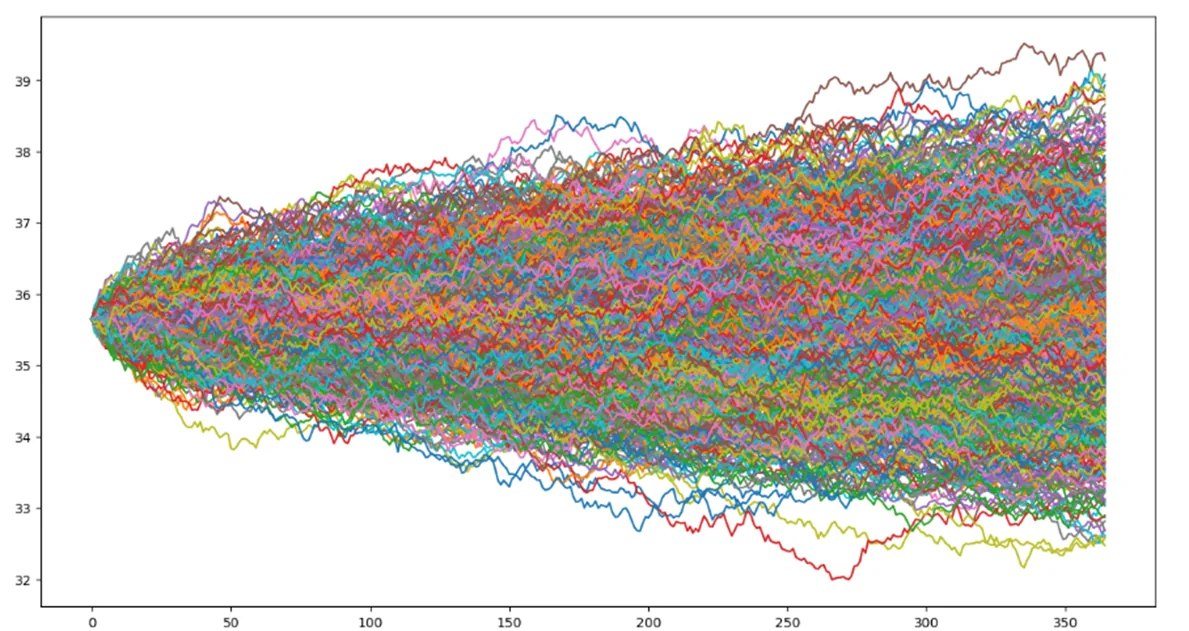
Periods of global chaos often provoke sharp movements in financial markets. Elections, pandemics, geopolitical conflicts, and unexpected economic announcements can rapidly change sentiment, and cause prices to adjust within minutes.
For many retail investors, these periods are quite uncomfortable. Your typical mom and pop investor may see their portfolio fluctuate rapidly, and predicting market direction becomes increasingly difficult.
However, for many trading firms and hedge funds alike, volatile conditions are not something to be afraid of. Volatility often creates a market environment where systematic strategies perform optimally.
What is Volatility?
Volatility is a measure of variation in the price of an asset over time. It measures how rapidly and unpredictably prices move.
In quantitative finance, volatility is typically measured as the standard deviation of asset returns. A market with low volatility experiences relatively stable price movements, while a highly volatile market exhibits larger and more frequent price movements.
A common misconception is that volatility indicates the direction of the market. This is wrong. Prices can be volatile while trending either upward or downward (or a mix of both). Volatility captures the magnitude and frequency of price fluctuations.
Historical vs Implied Volatility
In practice, volatility is commonly described using two distinct quantities: historical volatility and implied volatility.
Historical volatility measures how much an asset’s price has fluctuated in the past. It is calculated directly from historical return data, and provides a statistical estimate of how turbulent a market has recently been.
Implied volatility reflects the market’s expectations of FUTURE volatility. It is derived from the prices of options. Higher option prices typically indicate higher expectations of future volatility.
Significant global events often cause implied volatility to rise sharply, even before markets move. In effect, option markets begin pricing in the possibility of large price swings, even before those swings actually materialize.
What causes volatility?
Volatility emerges when markets are forced to rapidly incorporate new information. Several factors trigger such adjustments:
- Information shocks: Unexpected economic data, political developments, corporate announcements, etc.
- Liquidity shocks: When fewer buyers or sellers are willing to trade at current prices, markets can run thin, and even small orders can move prices significantly.
- Order flow imbalances: Large institutions repositioning portfolios, hedge funds unwinding trades, or even algorithmic strategies reacting strongly to signals can create feedback loops where price movements trigger volatile trading activity.
Why Quants Actually Prefer High Volatility
When markets become volatile, price movements become larger, trading volumes increase, and short-term inefficiencies tend to appear more frequently as markets struggle to absorb new information. For prop firms, these conditions are ideal.
High volatility leads to wider bid-ask spreads, which increases potential profits for liquidity providers (i.e. market makers). Larger price swings also create more frequent deviations from statistical relationships between assets, which is great for statistical arbitrage algorithms.
Volatile periods also bring much higher trading volume. For firms running automated trading systems, this increased activity translates into a large number of potential trades, and as a result, more opportunities to capture statistical edges.
Quantitative Strategies that Benefit from Volatility
Market makers continuously quote two prices for an asset: a bid price at which they are willing to buy, and an ask price at which they are willing to sell. Their profit comes from capturing the difference between these two prices, known as the bid-ask spread.
In calm market conditions, spreads tend to be very tight. This is because prices are relatively stable and competition between market makers is high. For example, a stock might be quoted at a bid of 100.00, and an ask at 100.01. In this case, the market maker can earn just one cent per share if they get one buyer at their ask price, and one seller at their bid price.
During periods of high volatility, uncertainty about fair value increases. To compensate for this, market makers widen their spreads. The same asset might trade at a bid of 99.90, and an ask of 100.10. The spread has now gone from 1 cent to 20 cents. This is significantly more profitable for the market maker.
What makes this even better for market makers is that volatile conditions typically bring a higher trading volume, as investors react to new information. This means that market makers not only earn more per trade, but also execute a larger number of trades.
When Volatility Becomes Dangerous (The Tipping Point)
We’ve discussed how volatility is beneficial for quants, but extreme volatility can often destabilise markets and be far too risky for the potential rewards.
During periods of severe volatility, liquidity can suddenly disappear, as traders widen spreads or temporarily step away from providing quotes. When this happens, small trades move prices significantly. In extreme cases, exchanges may halt trading altogether.
Black Swan events like these are why successful quant firms place heavy emphasis on risk management systems. This includes position limits, live monitoring, and dynamic hedging systems. Volatility can be desirable, but the most sophisticated firms understand where the tipping point lies between opportunity and market instability.
What This Means for Aspiring Quants
Understanding volatility as an aspiring quant is essential. Modern trading firms rely heavily on statistical models to interpret market behaviour. A core skill for quantitative traders and researchers is to analyze uncertainty, and design strategies that perform under different market conditions.
Aspiring quants therefore benefit from strong foundations in probability, statistics, and market microstructure. You can learn the core concepts formally from these courses, and ace your interview with our database of interview questions in probability and brainteasers, and online assessment simulations used by popular firms.
We hope you found this insightful! :)